Luxor
Luxor is located upriver (South) from Cairo. Fertile farm ground surrounds the city, whose more than 250,000 residents live and work primarily in the East Bank.
Tourism is strong on both banks of the river, as hotels, restaurants and shops are on the East Bank. Across the Nile, visitors can experience the desert while exploring the Valley of the Kings. Explore tombs of pharaohs from the New Kingdom. Egypt’s rich history, architecture, art, cultural heritage and spiritual connections are thoughtfully preserved.
During earlier times, Luxor was known as Thebes, the ancient capital. Its ruins lie within present-day Luxor.
Great strides have been made to preserve Luxor’s cultural heritage through conservation. Visitors fuel the economy. Sustainable tourism requires a balance between old and new while striving to minimize the environmental impact.
Do as the locals do and shop on the opposite end of the Market in Old Town for spices and textiles to avoid the crowds and vendors hawking their wares. At Luxor Souk, watch artisans at work and negotiate for a bargain.
What to See


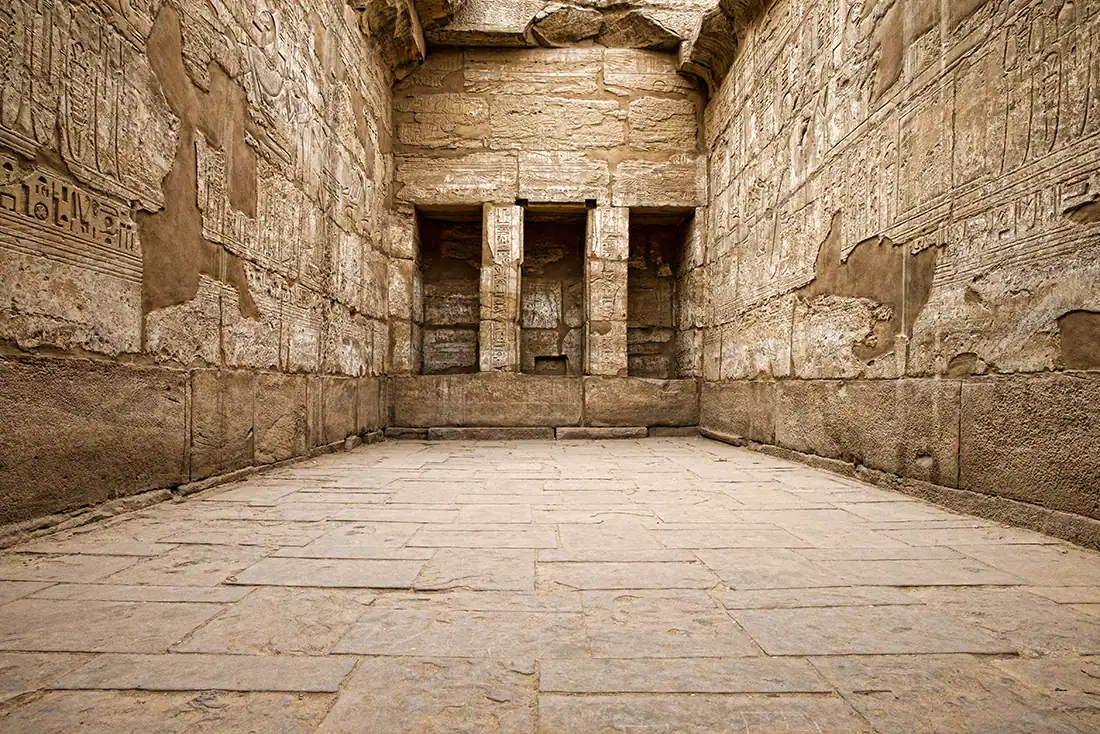
Luxor Temple, a UNESCO World Heritage Site
Housed on the East Bank of the Nile River in Luxor, formerly known as Thebes, was primiarily built during the New Kingdom (1570-1070 BCE).
Luxor Temple is dedicated to the Thebian god Amun, who was a protector of the city of Thebes. The statues of Amun, his wife, Mut, and son, Khonsu, a moon god, were brought here to celebrate the reaffirmation of the king’s rule with ceremonial rituals.
Construction began under Amenhotep III (~1386–1349 BCE), with later expansions by Ramses II (~1279–1213 BCE) and subsequent pharaohs. The temple’s entrance features colossal seated statues of Ramses II and a large obelisk, while interior courtyards and colonnades display intricate reliefs and carvings, including scenes of the Battle of Kadesh and other ceremonial events.
Luxor Temple, originally built by Amenhotep III and later expanded by successive pharaohs, was dedicated primarily to Amun and other deities, serving both religious and political purposes. Over the centuries, parts of the temple became buried under sand and urban development. Although Howard Carter is best known for discovering Tutankhamun’s tomb, Luxor Temple had already been cleared and studied earlier in the 19th century by French and other European archaeologists, including Jean-François Champollion, who deciphered hieroglyphs, and Emile Prisse d’Avennes. Subsequent work continued under the Egyptian Antiquities Service.
Visitors entering Luxor Temple are greeted by two colossal seated statues of Ramses II and a towering obelisk (its twin now stands in Paris). Inside, sunlit courtyards open onto grand colonnades, where intricate carvings and reliefs create a mesmerizing play of light and shadow. Massive pylons, adorned with depictions of Ramses II’s military victories—including scenes inspired by the Battle of Kadesh—frame the temple’s entrances, giving a sense of the pharaoh’s power and the temple’s importance as both a religious and political center.
Luxor Temple is connected to Karnak Temple via the Avenue of Sphinxes, a 1.5-mile (2.5 km) processional pathway.
The complex’s architecture is historically significant, reflecting the religious, spiritual, social, and political importance of those time periods. The layout symbolizes water, creation, balance and order.
Karnak Temple Complex
The Karnak Temple Complex, located north of Luxor Temple, is one of the largest ancient religious complexes in the world, covering approximately 250 acres (101 hectares). According to Guinness World Records, only Angkor Wat in Cambodia is larger, at 401 acres (162.6 ha).
Construction at Karnak began during the Middle Kingdom (circa 2055–1650 BCE) and continued for over a millennium, with additions extending into the Ptolemaic period around 204 BCE under Ptolemy IV. The complex’s primary sanctuary is the Temple of Amun-Re, the chief god of Thebes, while other areas were dedicated to Mut, Amun’s consort, Montu, a god of war and the sun, and additional deities such as Isis, Osiris, and Atum.
Karnak contains a vast array of structures, including temples, pylons or gateways, chapels, colossi, relief carvings, obelisks, and the famous hypostyle hall with 134 massive columns. One of its obelisks, honoring Queen Hatshepsut, stands as one of the tallest surviving ancient obelisks at 95 feet (29 m).
The complex is connected to Luxor Temple by the Avenue of Sphinxes, a 1.5-mile (2.5 km) processional pathway. Karnak was the center of major festivals celebrating both the pharaoh and the gods, with priests playing a significant role in ritual life. The Sacred Lake was used for purification ceremonies and other religious functions.
Over time, political instability, foreign invasions, and the growing influence of the priesthood contributed to the decline of the New Kingdom and the eventual emergence of the Third Intermediate Period (1069–525 BCE). Despite this, Karnak remains a stunning testament to ancient Egypt’s religious and architectural achievements.


Valley of the Kings
The Valley of the Kings is divided into the East and West Valleys, with the majority of tombs tucked into the East Valley’s rugged limestone cliffs. Before this hidden necropolis was established, pharaohs were interred in grand pyramids. After centuries of tomb robberies, New Kingdom rulers sought a more secluded and secure resting place, creating a hidden valley that has fascinated travelers for millennia.
This legendary site served as the burial ground for pharaohs from the 16th to 11th centuries BCE (the New Kingdom, circa 1550–1069 BCE). Today, roughly 63 tombs and chambers await exploration, including those of Tutankhamun, Ramesses II, Amenhotep III, and Hatshepsut. The discovery of Tutankhamun’s tomb in 1922 by Howard Carter revealed a treasure trove of gilded artifacts, intricate funerary masks, and vivid wall paintings, offering a rare glimpse into the lives and beliefs of ancient Egypt’s royalty.
Early excavations were often destructive, but modern archaeology prioritizes preservation, allowing visitors to marvel safely at these ancient treasures. Tombs are carved directly into the limestone cliffs, with descending corridors leading to elaborately decorated burial chambers. Walls are adorned with colorful paintings and hieroglyphs depicting funerary rituals, gods, and the journey to the afterlife. Highlights include the breathtaking tomb of Seti I (KV17), celebrated as a masterpiece of ancient Egyptian art; the beautifully decorated tomb of Ramesses VI (KV9), originally built for Ramesses V, featuring stunning astronomical ceilings; and KV55, a mysterious tomb associated with Akhenaten’s family.
Visiting the Valley of the Kings offers an unforgettable journey into Egypt’s royal past. Each tomb tells a story of power, devotion, and artistry, drawing travelers from around the world and contributing significantly to the vibrant life of Luxor today.
Resources: Old Kingdom, Middle Kingdom, New Kingdom, Guinness World Records, Karnak, Karnak Tempe,


